In 2024, I taught a self-designed introductory metaethics course to Notre Dame undergraduate non-majors.
What follows are some of the slides and visual aids I composed for the course, which others may find interesting or helpful.
A (SIMPLIFIED) ROADMAP THROUGH THE LANDSCAPE OF METAETHICS
The first half of the course consisted in a "tour through the landscape of metaethics." I used the following flowchart as our "roadmap" through that landscape, which - in tandem with our discussions, of course - I felt helped the students to understand how the various views hang together, which, in turn, helped them to understand the various views themselves.
This flowchart is in various respects oversimplified.
-
First, the flowchart concerns moral judgments/claims/properties/facts generally, rather than Fness judgments/claims/properties/facts, for some particular moral property, Fness. The flowchart therefore excludes views that handle different moral properties differently.
-
Second, fans of Sturgeon-style non-reductionist naturalism may complain their view is not represented. Given how I think of reductive definition, I would actually resist this claim. But it would take me a bit to explain why.
-
Third, the flowchart does not leave space for reductions of moral normative phenomena to non-moral normative phenomena taken as irreducibly normative.
-
Fourth, fans of views that disentangle the question of a moral judgment's truth-aptness from that of the corresponding moral claim's truth-aptness ought to complain that the flowchart leaves no space for their views. Quasi-Realism isn't strictly a view of this sort, but, in a similar vein, the flowchart leaves no room for the Quasi-Realist's particular combination of moral psychological commitments and semantic commitments.
Were I to teach the course for majors, I would at least upgrade to using the schema of which the last, more sophisticated flowchart in the sequence is an instance, which handles the first and third of these problems.


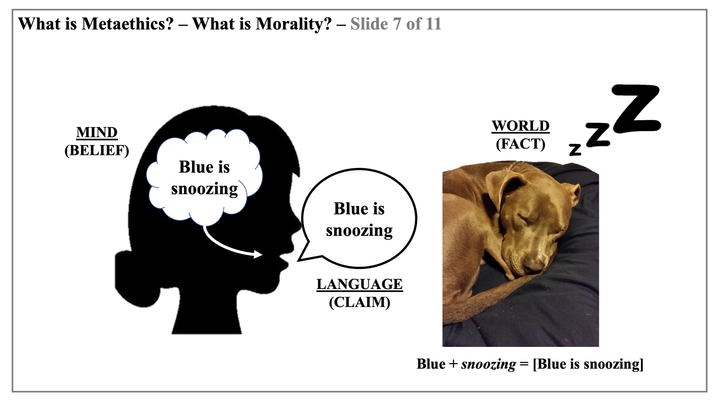
DISTINGUISHING MIND, LANGUAGE, AND WORLD

You can't get far in metaethics without a sturdy grasp of key distinctions between mind, language, and world. So I attempted to present such distinctions early on by way of the following slides, and to call back to them regularly throughout the course.



DISTINGUISHING DIFFERENT "GRADES" OR "STRENGTHS" OF MORAL REALISM
I find it helpful - both pedagogically, and in the course of discussions with other philosophers - to distinguish different "grades" or "strengths" of moral realism, along the lines I propose in the slides below.


